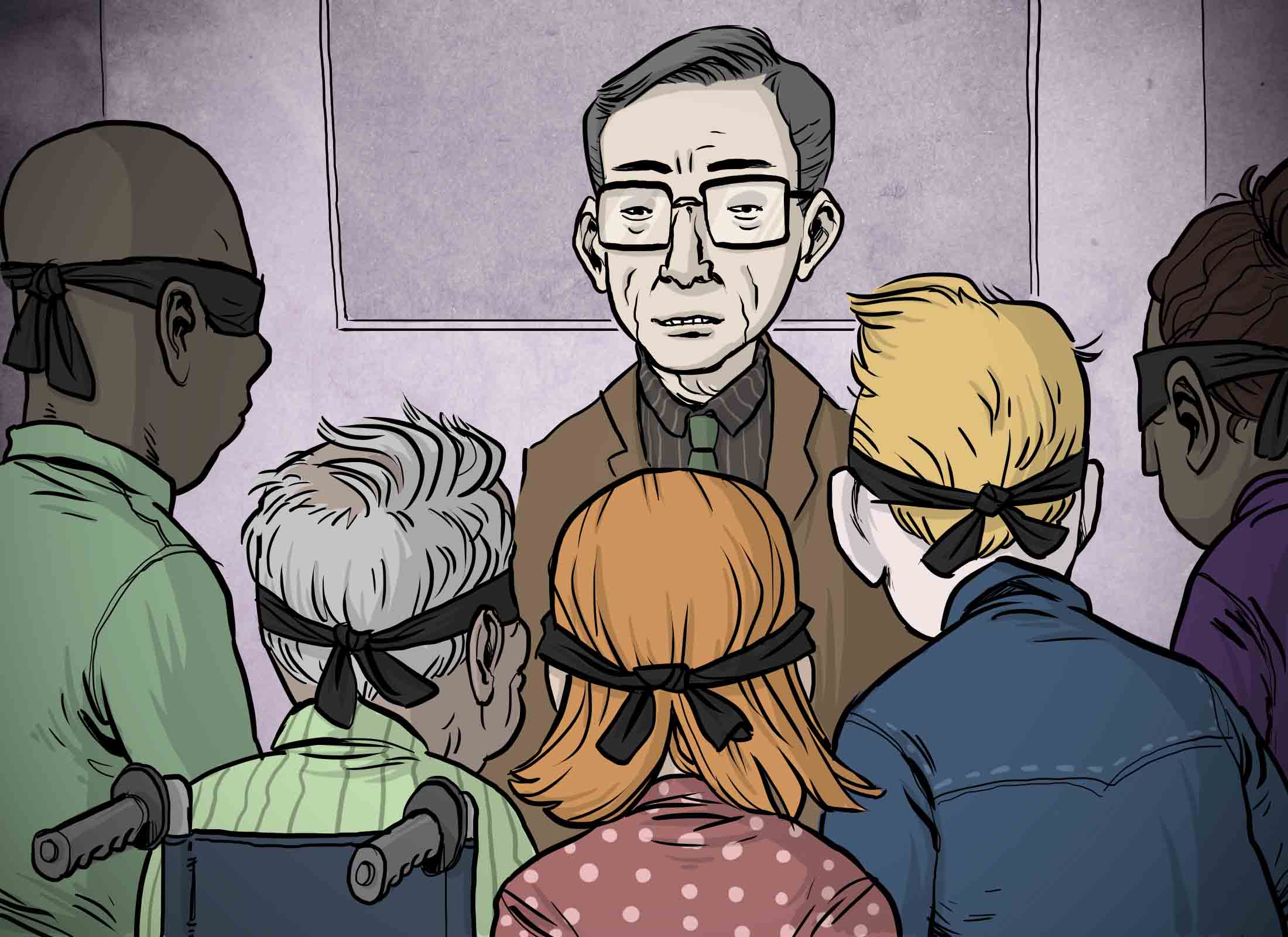
You walk into a conference room filled with people wearing blindfolds. “Hurry, put on your veil of ignorance,” Rawls says to you as he thrusts a bandana into your hands. You secure the cloth over your eyes and wonder what kind of masquerade party is about to happen.
Rawls continues talking. “Welcome, everyone! I know that wearing these blindfolds is a little bit awkward, but it is necessary for our social experiment. With your veil of ignorance on, I want you to imagine that you’re completely blind to your own talents, education, career choices and so forth. You don’t even know your own gender, race, and age. You are also blind to the predilections and capacities of those around you. We are all in a state of complete blindness to our social positions. In short, we are all in what I term the ‘original position.’”
“Now, from this original position, we must write a social contract that orders society and helps distribute wealth. Because we are completely blind, we won’t be biased in favor of our own capacities. For instance,” Rawls taps you on the head, “some of you look like you are students. If you had that information, you are likely to design a social contract that favors education pursuits. If you knew that you came from a family of great wealth, you’d design a contract that preserves inheritances and favors the rich. On the contrary, if you knew that you came from abject poverty, you’d design a system that supports the poor. The veil of ignorance strips that all away so that we can design our social contract without prejudice and bias. The process will be fair and just. Let's begin.”
A voice immediately shouts out, “First, I think we need to establish some basic liberties and freedoms that our government cannot infringe upon. These liberties should be as extensive as possible as long as they don’t infringe upon the liberties of others. For instance, we should all be able to own personal property. The state should not be the sole owner of all things.”
There is a murmur of agreement among the group until an elderly voice pipes up. “However, we need to be careful with property matters because accumulation of property can lead to inequality. Since I might come from a position of poverty, I’d at least want some type of assurances that I will be able to survive. I mean, we need to protect the least advantaged in society.”
“That’s true,” a youthful voice at the back of the room agrees. “But I don’t want a complete welfare state. We need to make sure that people who work hard are compensated for their efforts. That is only fair. I don’t think we should have a state where everyone receives the same share of resources no matter their level of contribution. We can’t eradicate social inequality!”
Rawls interjects, “Remember everyone, your veil of ignorance blinds you to your actual position in society. Any one of you could be the poorest of the poor. You probably want to design some type of safety net to mitigate that risk.”
The room is silent until another person states, “We need to reward effort but still take care of the worst off. We need a way to deal with the social inequalities that are part of every society. What if we arrange our social system to the greatest benefit of the least advantaged? In other words, we guarantee that the worst off still receive a fair deal. That way, those who are talented and work hard will still be rewarded, but the least advantaged at minimum won’t be hurt by our laws.”
“That is a great idea,” Rawls interjects. “Let’s call this the Difference Principle.”
“Hold on a minute!” the woman from the back says. “I am all for limiting this type of risk. But I just think that we can’t limit opportunities. Along with the Difference Principle, we also need to ensure that all positions or offices in our society are open to every individual regardless of race, sex, or social background. This would allow everyone to have an opportunity to succeed. I call this the Fair Equality of Opportunity Principle.”
“Very good,” Rawls states. “Let’s recap. Our social contract will ensure basic liberties for all people. It will allow equal access to careers or positions in the society. Finally, social policies will maximize benefits for the minimum positions. You have all done well in this experiment. Of course, this was all hypothetical. ‘Each person finds himself placed at birth in some particular position in some particular society, and the nature of this position materially affects his life prospects. Yet a society satisfying the principles of justice as fairness comes as close as a society can to being a voluntary scheme, for it meets the principles which free and equal persons would assent to under circumstances that are fair.’”[2]
The participants pull off their blindfolds and begin to chat happily about their accomplishments. However, you can’t stop thinking about the advice you received in the elevator. The thought experiment was interesting, but is it really possible to divorce ourselves from who we are as persons in order to determine the nature of justice? With this nagging question, you slip out of the room and walk back to the elevator.
[2]John Rawls, A Theory of Justice, 1971.
