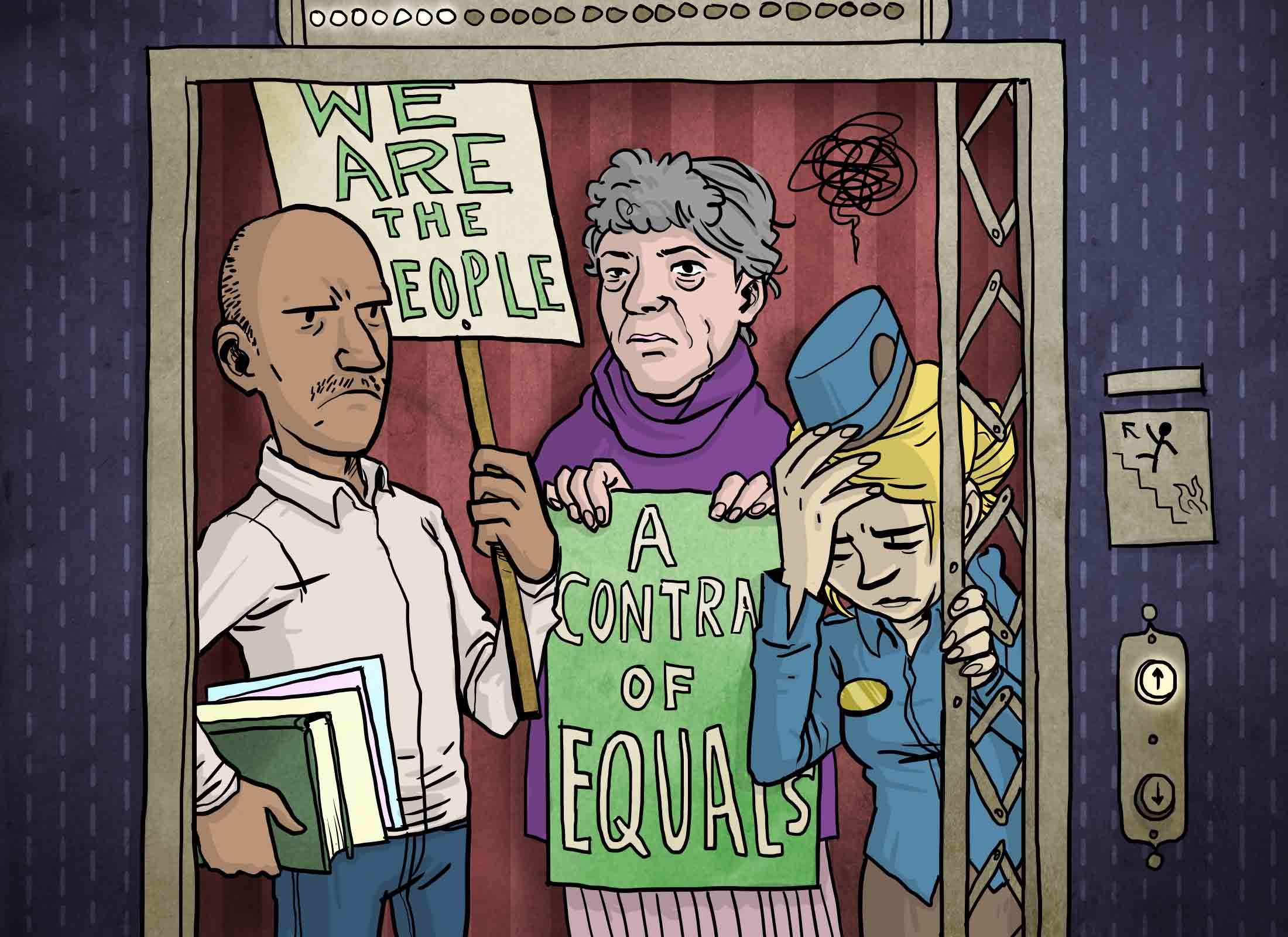
Your upwards glide is abruptly halted half way up as two angry looking individuals jump into the box. “Yeesh, protestors!” the operator says with dismay.
“Oh, get over yourself,” one of the newcomers says. “We have every right to lodge our protest. These supposedly hallowed halls have never welcomed those who might have a different point of view.”
“How can you say that!” exclaims the operator. “The lobby of this building is a wide open space where anyone and everyone can enter and join freely in the social contracting process. There are windows everywhere to promote transparency. Anyone in my elevator is free to travel to any part of the building.”
“Yes,” responds the female. “But I have noticed that once you step off the elevator, the corridors narrow and become constricting. As you survey the conference room, most of the participants are male.”
“And White,” the other passenger adds. “While this building was built as a testament to freedom and open participation, that is not the reality. Social contract theory is not gender-neutral, race-neutral, or class-neutral. When you look at it closely, the theories cater to White men.”
The woman turns to you and says, “We were just discussing some of the pitfalls of social contract theory.” She hands you a business card which states her name is Distinguished Professor Virginia Held. She continues, “Locke and Rousseau speak of a type of ‘economic man’ who enters into a contract to maximize his own self interests. This does not adequately represent the role of women as care takers. When we make ethical decisions, we should not be so concerned with the terms of the contract but should instead concern ourselves with the relationships we have with one another. I argue that patriarchal control of women is found in much of social contract theory.”
“I agree,” says the gentleman whose nametag reads Charles Mills. “Historically, when people meet around the hypothetical conference table to hash out the social contract, those individuals have been White men. For much of history, non-Whites were not considered persons and therefore were not a part of those allowed to participate. White men who have the power are allowed rights and freedoms. The rest of us are denied these privileges and are simply the objects of contracts. Sure, the process of formulating a contract is supposed to completely open to all rational individuals without exclusion. But is this the reality? You are about to participate in a social contracting process. Keep this in mind as you delve into it,” Mills advises as you step off the elevator.
Not sure what he means, you begin walking down the hallway looking for the rooms allocated to John Rawls. As you walk, you notice that the corridor is a little bit narrow.
