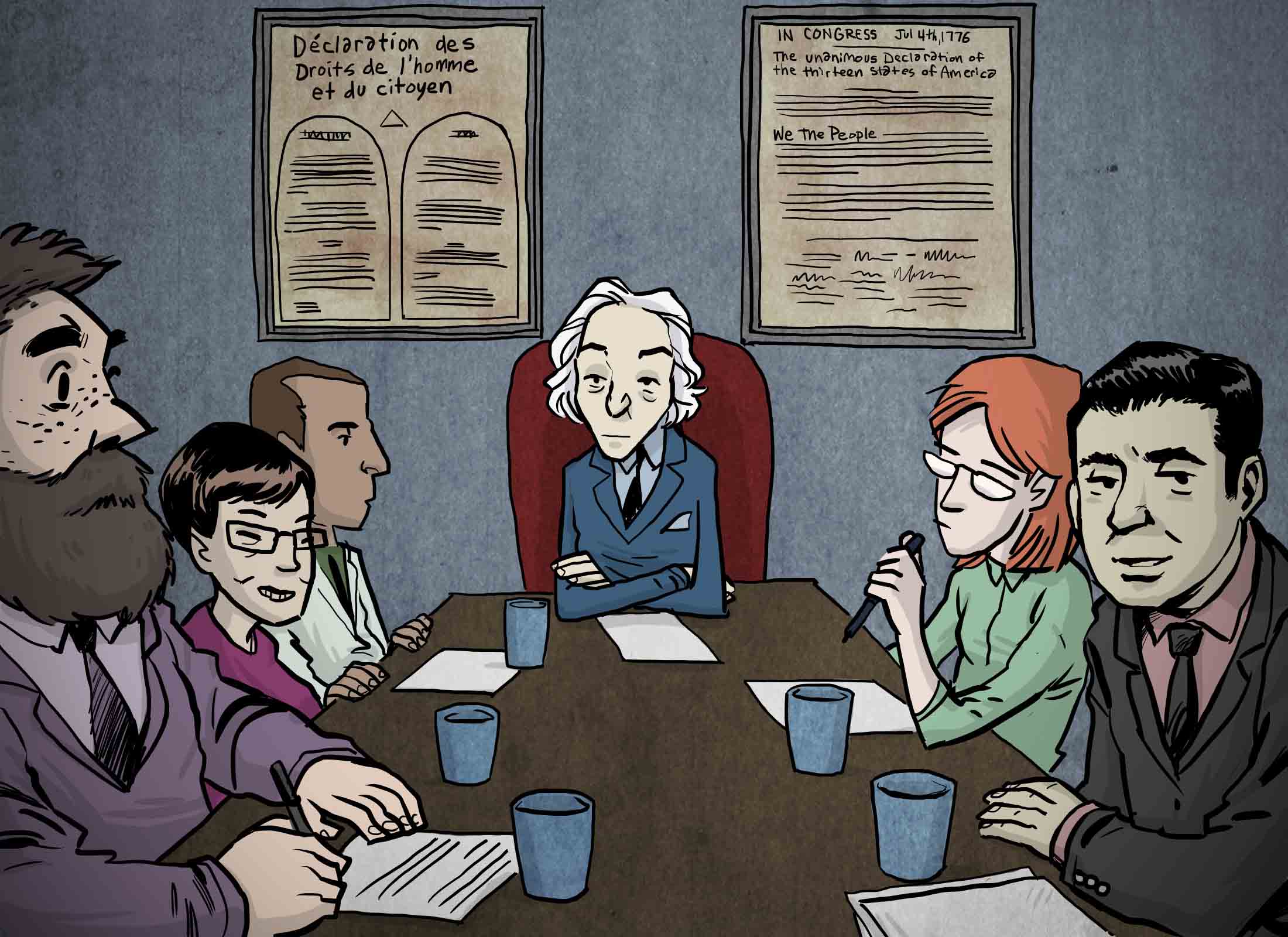
You walk down the hallway until you see a placard on the door that says “Locke’s Treatises.” Hoping that you are in the right place, you step into the conference room expecting to walk into the fray of a heated argument as people hash out the terms of a contract. Instead, those gathered around the table are speaking in civil tones and seem to be agreeing to the terms they are writing on the blackboard. “Excuse me,” you apologize, “I was looking for the battle taking place in Locke’s conference room. I can see that I’m in the wrong place.”
“Blimey! On the contrary,” exclaims a sharp-looking English gentleman. “I am John Locke, and we are in the midst of stepping out of the state of nature and forming a social contract. I'm surprised at your hostile impression. We are free, rational, and social creatures who are not inclined to fight. In the state of nature, people are generally amicable and kind to one another. Now my mate Thomas Hobbes disagrees with this idea of nature, but he is not in the office today to explain his theories of power. I hear he’s got a bloody-good movie deal! Anyway, my notion of the state of nature is much more benign and even friendly.”
Confused, you inquire, “If nature is so wonderful, then why would anyone want to leave this state and enter into a social contract?”
“Well, there’s the rub,” Locke replies. “All of us here are industrious folk, and we have been working jolly hard mixing our labor with the raw materials of nature. With her skill and hard work, Kazuyo cut down the trees to fashion a lovely flat until intruders threatened. Emeril spent the day fishing to make a scrumptious gumbo, but when he returned to his kettle, someone had nicked it! While the state of nature is nice, our property simply is not protected. So we’ve come together to form a contract to protect what is rightfully ours.”
“But how is this contract going to protect you and your property?” you ask.
“We have each freely agreed to give up our power in order to protect ourselves and punish transgressors. Instead, we will vest this power in an impartial authority who can establish laws and ensure that these laws are obeyed. The social contract creates this sovereign who can develop clear laws and resolve disputes.”
“I understand why you would want to establish a sovereign to protect the fruits of your labor, but don’t you worry that a potentially oppressive government could be worse than the state of nature where at least you are free?”
“Yes, that is always a worry. But the purpose of government is to protect and uphold the natural rights of men. If the government fails to do this, it can be overthrown. A legitimate government upholds ‘life, liberty, and estate.’[1] During this process of creating the social contract, we base our decisions on the consent of the majority. Because those of us in this room are rational and free, this sovereign we create derives authority from our consent.”
“This theory is a really novel way to conceptualize the formation of government. I think this would be quite useful when I return to my own people and try to form our society.”
“Yes, my teachings have been widely influential.” Gesturing to the framed documents lining the walls, Locke continues, “The American Declaration of Independence actually borrows many quotes from my work. Please, take a copy with you as you continue your journey.”
Happy with the additions you’ll be able to make to the library, you start walking down the hallway towards the elevator.
[1]John Locke, Two Treatises of Government, 1689.
